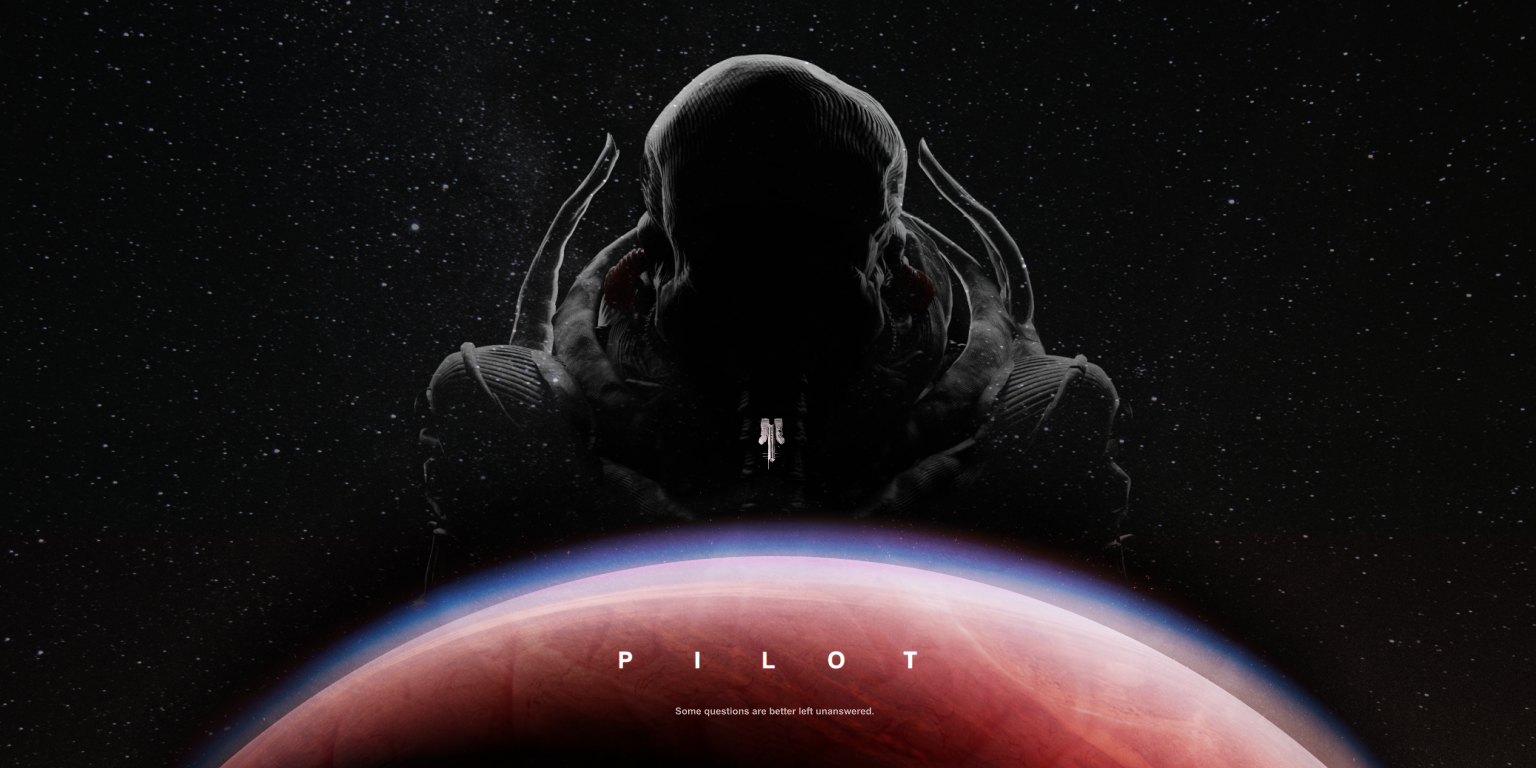
PILOT is an immersive narrative made in, and for, VR. The story is a direct continuation of the 1979 film Alien and is my love letter to H.R. Giger’s vision.
This is a 10+ year personal (not professional or paid) passion project. Creative therapy. A place where I learn and grow. All in honor of the world H.R. Giger, Dan O’Bannon, Ridley Scott, and others created.
The Spark
I’ve wanted to make a film with the Space Jockey since I was a kid. Its brief appearance in Alien was one of the most impactful moments I’ve seen on film. Now, since VR + Quill gives creatives everything they need to be a one person show, I’m ready to bring my childhood imagination to life.
The mystery around the Space Jockey (Pilot as it was called in production) has stuck with me over the years. I always wanted to see more of that mysterious character as a terrifying CREATURE. Not a familiar being that has ties to humanity like the Engineers in Prometheus. So I set out to make the movie I always hoped to see one day.
Challenges
I’m constantly debating with myself if I should even touch the Alien universe. There are major reasons to leave it alone. For one, as of 2025, it's like beating a dead horse. My thoughts on this are better articulated by this Patrick (H) Willem’s YT vid. For another reason, 1979 Alien is a MAGICAL point in film history. All the right people (some of the greatest creatives ever) came together at the exact right point in time. They were already hyped up, and battle tested, as a team having worked on Jodorowsky's pitch for Dune. When they moved over to Alien they pushed themselves and brought a perfect movie into existence. And somehow I am going to contribute anything of substance? Haha, it would be insane arrogance to think I can even stand in their shadow. I’m doing this in my own little world because I'm compelled to. But I’m fully aware I'm dipping into sacred waters.
Research
To find the right balance of existing lore and new elements I combed through as much reference material as possible. I wanted to surface ideas the original creators were exploring. I also wanted to get to the core of what drove their design thinking. Deeply understand the motivating forces that inspired them. With that foundation I can create new ideas that feel authentic. I also looked at adjacent stories like Dark Star, The Thing, Annihilation, and especially At the Mountains of Madness. These all involve similar themes and some even inspired the Alien film itself.
Story
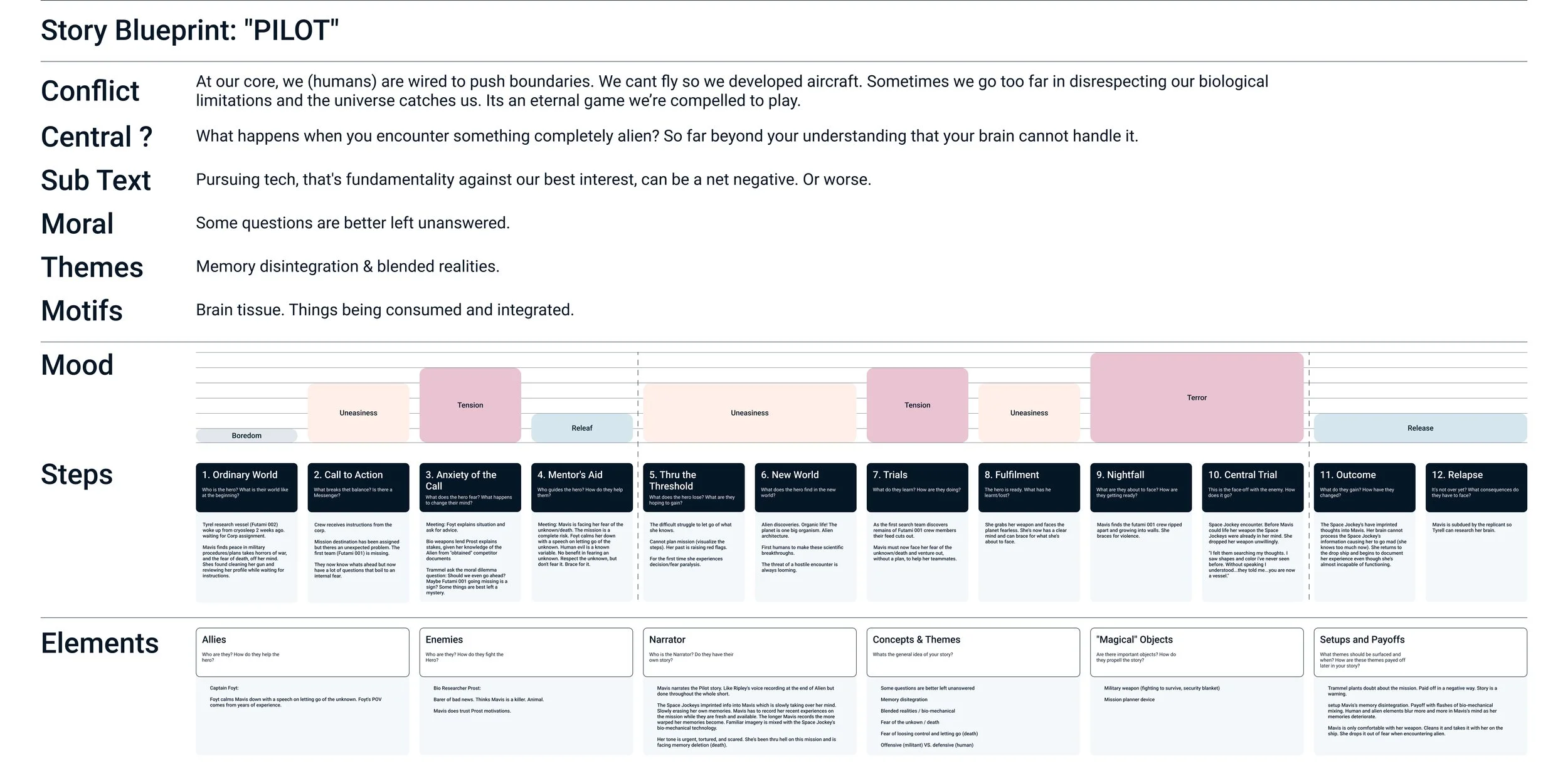
Synopsis: A crew of five and one replicant, aboard Tyrell Corporation’s emerging technology research vehicle ‘Futami 002’, are on a mission to beat Waylin Yutani to an undiscovered planet. Contact with the mission’s first vehicle ‘Futami 001’ has gone silent. While searching for the missing vehicle, the crew of ‘Futami 002’ encounter a horrific world beyond their understanding.
This is a cautionary tale around humanity’s drive to reach beyond our natural abilities, in pursuit of growth, and how that can lead to madness. It’s a risky game we play. Sometimes we push too far and loose control. Some examples that come to mind - flight, social media, infectious disease research, ASI eventually?, etc.
Mystery
Alien (1979) is described by some as a haunted house film in space. It’s claustrophobic, scary, and mysterious. The Alien and Space Jockey don’t have an explanation. They are monsters made more terrifying by being mysterious.
Setting
Giger’s original idea for the alien planet (LV-426) was to make it a bio-mechanical landscape but the film’s budget limited his vision. So in Pilot I want to bring his idea to life and make the planet one big pulsating organism. I also want to take this further by setting this planet as the Alien’s home world.
Delivery
Given Pilot is only a slice of a longer narrative, and I don’t have enough time to flesh out characters just with visual animation, I will focus on a single character through monologue. I’m also going for a very moody feel that’s dipped in nuance. So, Viewers will benefit from having seen the first Alien film. Additional detail will be available via environmental storytelling and will be a reward for exploring the sets physically.
Feel
Where Alien felt claustrophobic I want Pilot to feel IMMENSE and intimidating. Its in VR and features the Space Jockey after all. Scale is king. The other take away is I want the audience to feel uneasy through unexpected explosions of violence/action. Alien is famous for this and I think its a key ingredient to its success.

Design
Overall Philosophy
Much like Giger’s bio-mechanical design I intend to blend references into new forms that feel alien with a touch of familiarity.
Visual DNA:
Bio-mechanical - For obvious reasons.
Telescoping forms and linear repetition - Quill strokes, stylizing of Moebius and Giger, machined parts, etc.
Chameleon Effect - I’ve incorporated of a lot mixing between human and Alien. A core concept of Giger’s work. Further analyzed in Rob Ager’s Chameleon Effect commentary.
Color Palette
For simplicity's sake, I want to make the final story monochromatic with the scenes in space leaning cold while the planet is warm with flesh tones. The contrast from cool to warm will hopefully help orient viewers since VR can be disorienting by nature.
Lighting Design
To simplify production, and create a spooky atmosphere, I will create one “pool of light” source per scene. This will also help focus viewers' attention. In the dark areas I will sprinkle in decorative light fixtures and tech, like control panel buttons, to give it a sense of space/boundaries without the need to create a bunch of geometry. This also helps me optimize performance.
Animating Light
Since I have to hand paint everything in Quill (there is no lighting engine) I needed to figure out a way to animate light. At the time this was not yet figured out by anyone. So I came up with a technique that involved duplicating geometry, painting it as a lit color, and animating that layer via keyframes. It's not the most efficient in terms of performance but it allows me to get smooth animation vs a frame by frame approach - which would take too much time and effort anyways.
Experiencing Immersive Media
Pacing
Immersive media (see Sleep No More) affords a whole new type of narrative exploration. So I need to find a way to balance linear progression/momentum vs giving viewers time to stop and explore. I go back and forth on how I should approach this balance. VR really shines when your creating amazing places to escape and hang out. But there's also a threshold for how long you want to wear a headset. I will probably only know what my pacing looks like after testing. 10 min play-throughs (not counting exploration time) seems like the sweet spot. Dear Angelica is the benchmark.
Unique to VR
I love rewarding people for making the effort to physically explore my work in VR. I know people snoop around so I add all kinds of Easter eggs for them to find. These can be in the form of 3D objects, messages, animation, spatial audio, or all the above. This super charges the immersive aspects of spatial storytelling and is what makes VR so unique. It's one of the main reasons why I love VR.
VR Consumption Guide
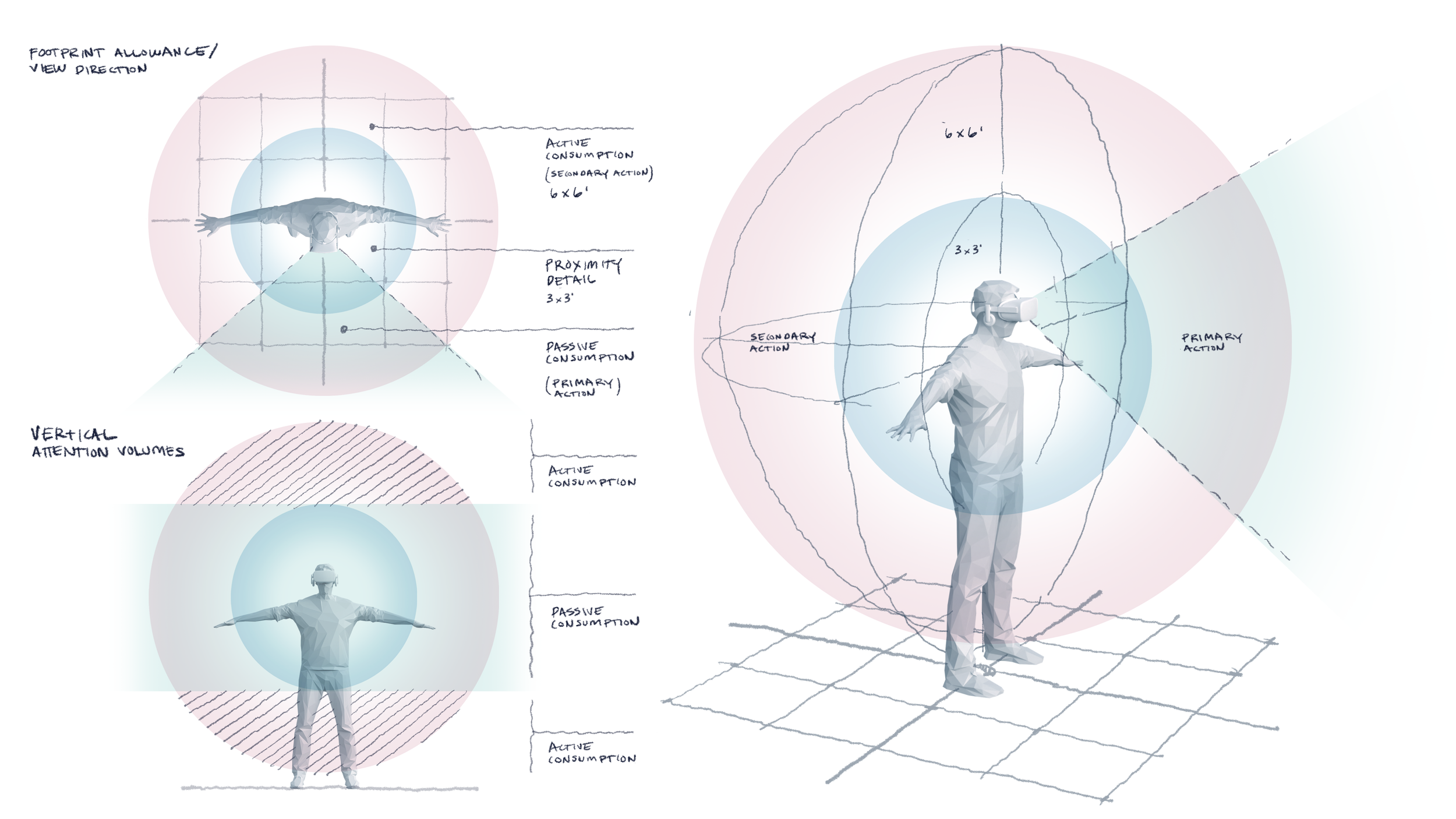
I’m designing Pilot for two audiences. First is the core/passive audience who will be stationary looking straight ahead. My secondary audience will be more active and physically engage by walking and looking around. I plan to design for both by making sure the core narrative is visible from a stationary FOV. But if I only stick to this approach then there won't be a strong case for experiencing Pilot in VR. Viewer agency is one of the main reasons VR narratives are so unique and immersive. So I will make sure to reward my active audience by making all the sets full of things to discover which will hopefully encourage people to return and spend time exploring.
I created this guide to help me plan and think about the story spatially. However its only a starting point. I will only be able to figure things out by testing and building directly in headest.
Poster Design
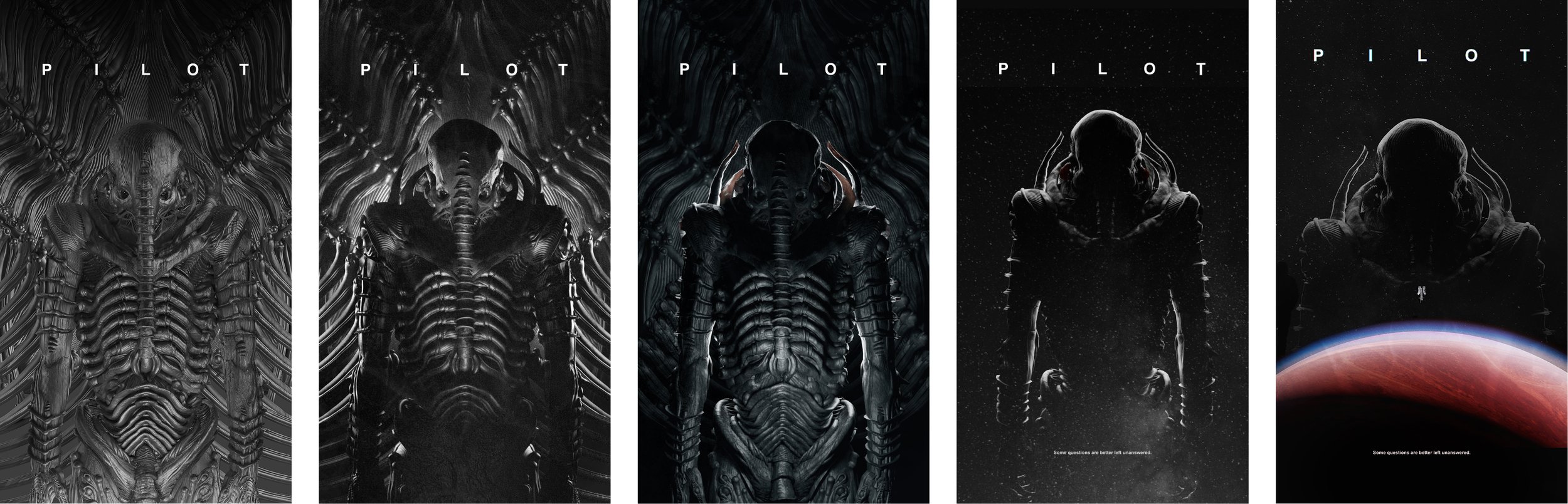
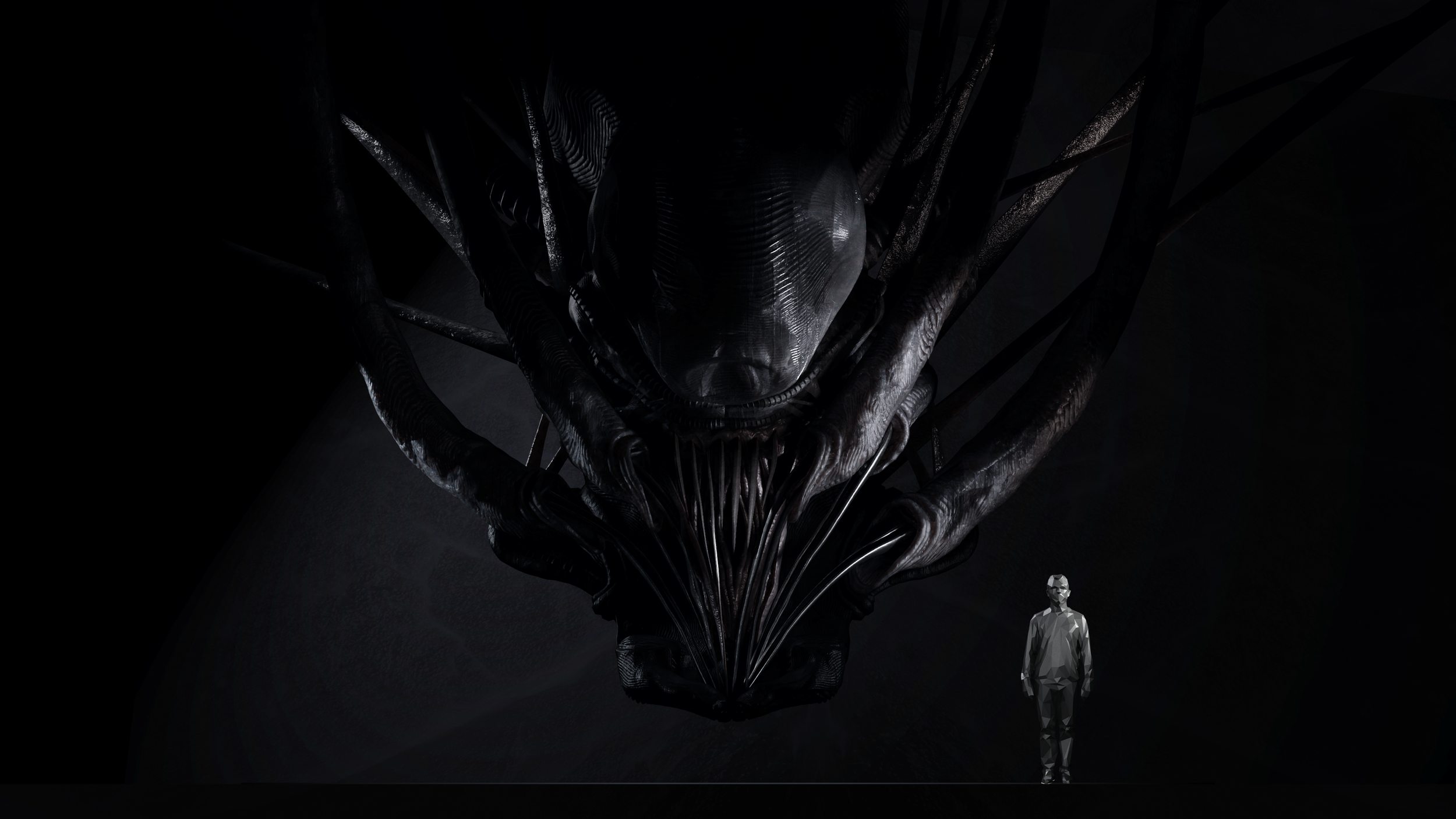
The poster for Pilot has gone through many iterations over the years. Initially I wanted a familiarity with the 1979 Alien poster. I mean it's iconic so of course I wanted to tap into that somehow. I also wanted to make it all about the Space Jockey. I explored looks that reference Giger’s film design book “Giger’s Alien.” Which fused the creature into the background so they become one. But no matter how I lit the Space Jockey it was just too revealing. So over time I pulled back the lighting, making it more of a teaser. This gave it a much more cinematic feel.
Creatures
The Space Jockey
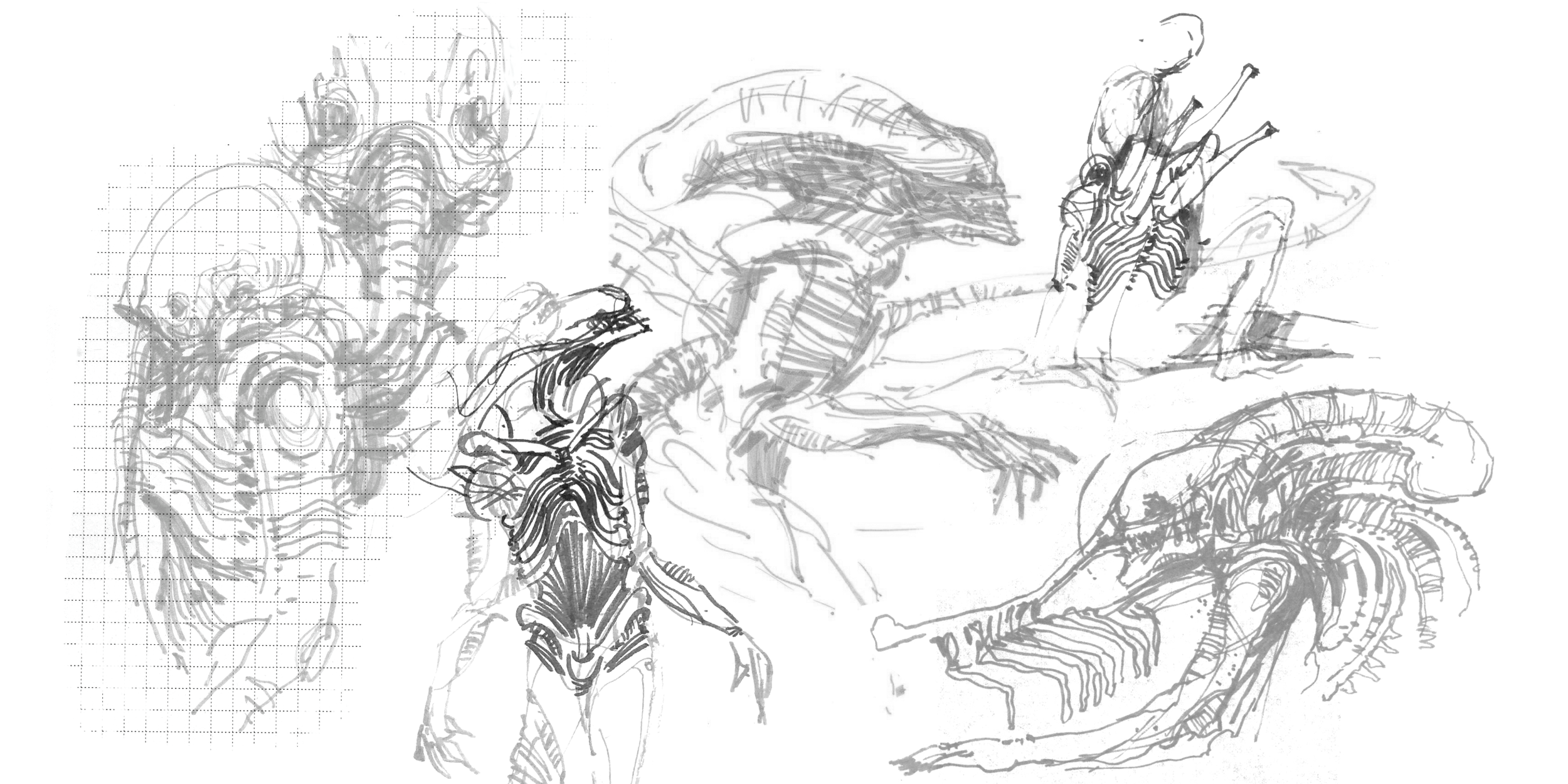
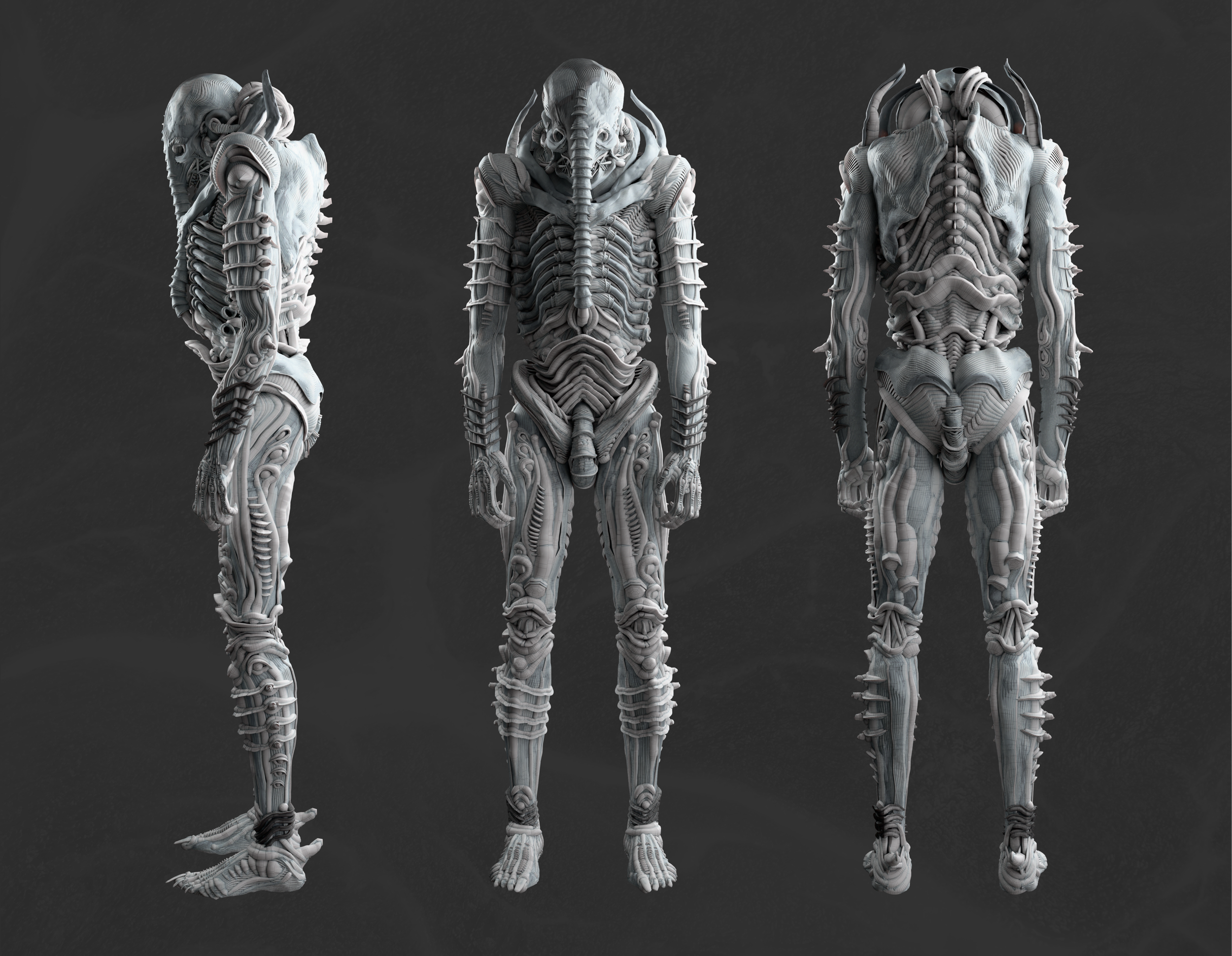
What if Ridley asked Giger to build a standing suit for both the Alien AND Space Jockey during film production? This was the central mindset I put myself in while designing untouched aspects of the Space Jockey. Things like its back, legs, bottom torso, and what it would look like alive. For continuity, I blended a bunch of details from Giger's suit for the Alien. I took a guess on how Giger MIGHT have designed this under Ridley's Direction.
Design
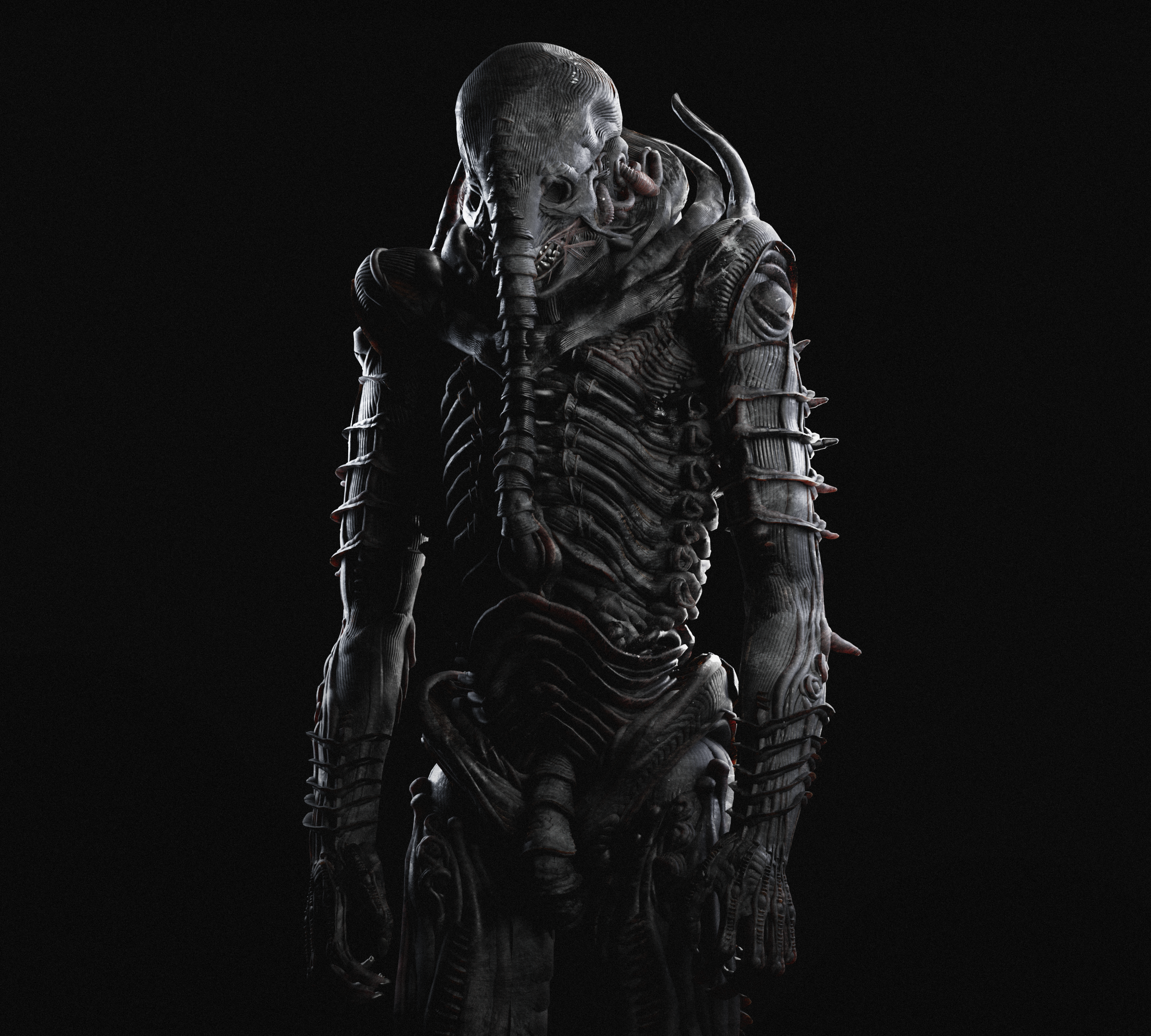
I’m basically taking the Space Jockey into monster territory. I imagine a living Space Jockey would look similar to the Alien itself. It’s black, slimy, has shiny human-like teeth, and an exposed jaw with rubber tendons keeping it together. Most importantly it's a gross mix of flesh and mechanical-looking parts. To me, the subliminal sexual imagery is what makes the Alien so striking. I'm including reproductive type organs that blend into each other. Unlike the Alien, in my short story, the Space Jockey has an exposed skull. The eye sockets are empty which is inspired by behind-the-scenes photos I saw from Alien as a kid. The empty eyes make it hard to connect with it (alien to us) which is the whole point.
New Role
I will upset some die hard fans by taking the Space Jockey out of its chair. And I hear you. I agree that it’s much creepier and mysterious when fused to the chair. The “born into its function” element is very cosmic horror and I love it. But I also want to encounter it in immersive horror scenarios which would be hard if it were still confined to the chair. Besides, its massive scale and visual design are more important elements for me personally. I will find ways to fuse the Space Jockey to its surrounding architecture in other ways. I will also introduce a new giant creature that fulfills the “born into its function” element.
New Ideas & Inspiration
Even though I want to keep the Space Jockey mysterious I also want to add new details. My main inspiration for how to make it even more alien is to take notes from the character Nagilum who appears in the Star Trek: The Next Generation episode “Where Silence Has Lease.” I love how alien that character is. It's really just curious and wants to probe. I think the Space Jockeys can have similar motivations. When they first encounter humans their instinct is to study and explore. Their methods are confusing > scary > violent to our human standards. Kinda like those abduction scenes in Fire in the Sky. I’m also taking inspiration from Dune’s Spacing Guild Navigators. Just like the navigators, Pilots in my story harness their power by infusing themselves with the Alien home world. Their technology grossly consumes the planet’s god like resources. This process is a sacrifice to their own bodies as both the Space Jockeys and planet fuse together into a grotesque byproduct over time. So in a way I am still including the “fused to its chair/born into its function” creepiness. And this lore idea won't be explained. It will appear in various world building details.
Abilities
In my story the Space Jockey communicates telepathically by implanting information into our brains. The process is so disruptive to our biology that it causes people to slowly go mad. As the story progresses memories and images mix becoming completely alien.
Notes on Lighting
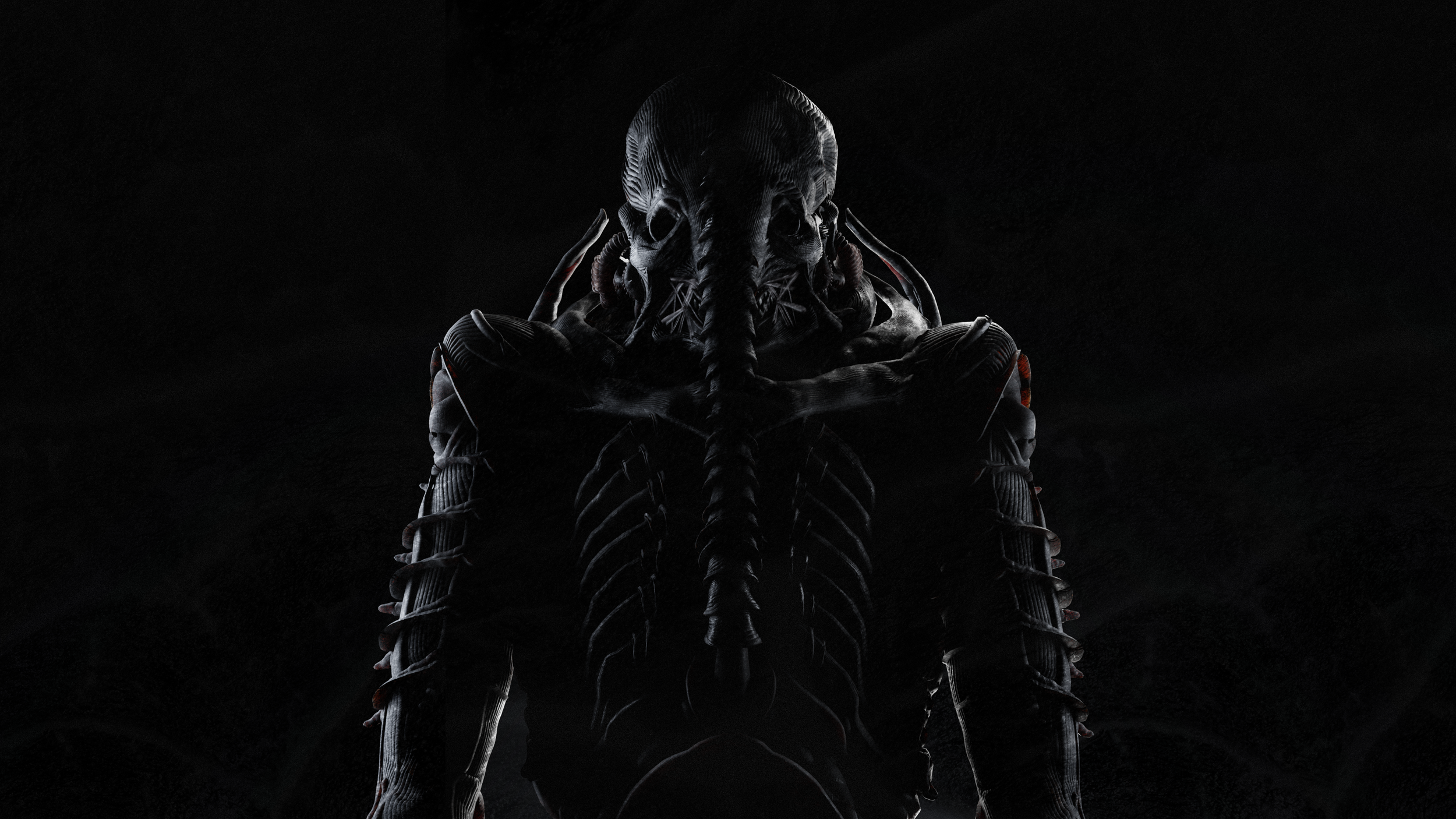
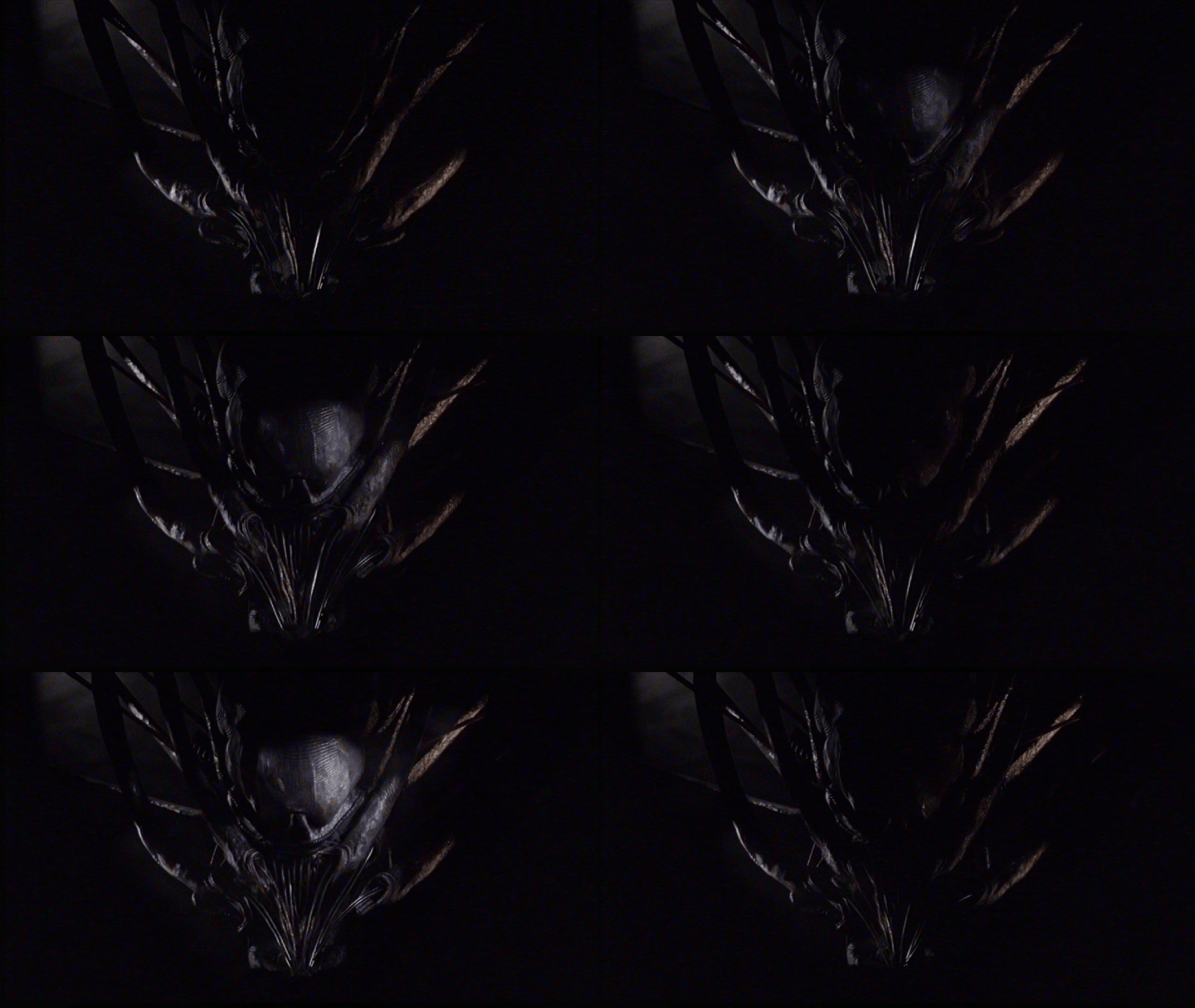
Even though I want to show off this creature in all its glory, the intrigue comes from it living in the shadows. Just like the alien. You never fully light it or the whole thing falls apart (See the Alien Earth show. No offense to the team). I constantly debate myself if I should/shouldn’t show the designs off before people get to see it in the final VR experience. I worry these images overexpose it which breaks my whole point of it “living in the shadows.”
“What is that thing?!”
There’s a major problem with new Alien related media (all media I guess). Everyone’s seemingly terrified of the fans and so they end up showing things we’ve already seen over and over. The same xenomorph, exact locations, sounds, even repeating the same lines from previous movies. This violates film 101 right? Don’t show people things they’ve already seen or they’ll tune out. A big part of my work on PILOT has been finding ways to enhance familiar elements in the universe with new ideas, angles, and details while maintaining the original creator’s spirit. Sometimes introducing new lore that, if done right, achieves the same impact. That’s where this creature comes in. I want to recreate that feeling the Space Jockey imprinted on me in Alien - A wild looking, massive, and mysterious creature that’s hard to describe. Something totally alien. Grown into its function and fused to the surrounding architecture (also a living organism). It’s new and different. But with the same desired impact. In the spirit of the original creators. Also, I don't want to ruin the mystery and think too much about this creature’s role. I'll just show it in the final VR experience. Let the audience wonder.
This creature’s design is inspired by HR Giger's Necronom II: The Watchers of Cirith Ungol painting. Which I only saw a zoomed in version of as a kid in one of the Alien comics. This painting, and a few other behind-the-scenes photos, opened a whole new world to me. Vast and mysterious. So much left to discover. I didn’t even know there was a skull hidden under the xenomorph’s dome until I saw these behind-the-scenes photos later on. I didn’t even know what to make of it at the time. Maybe this urge I had as a kid, seeing those images and wondering, is the core reason I'm making this film.
Characters
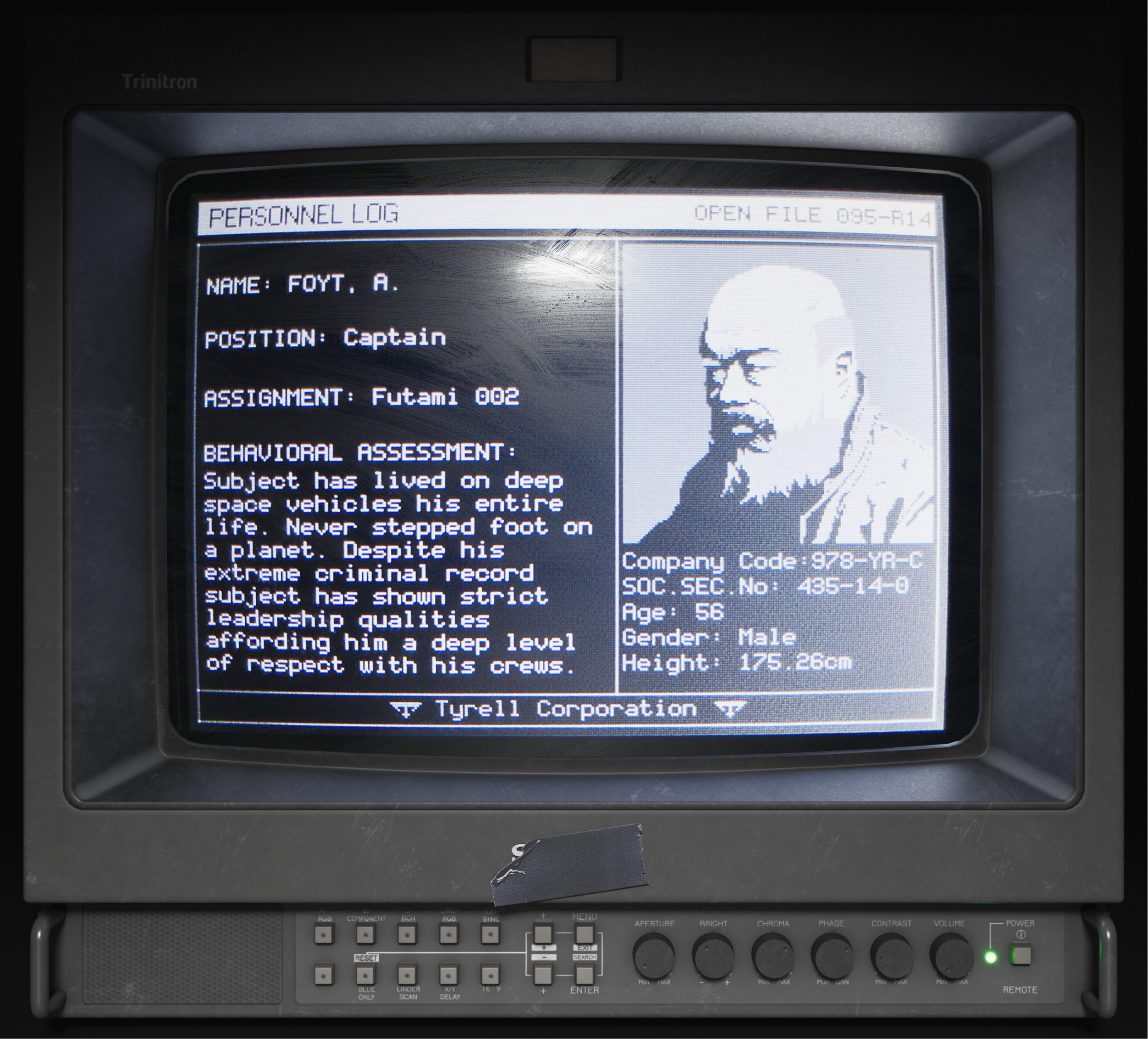
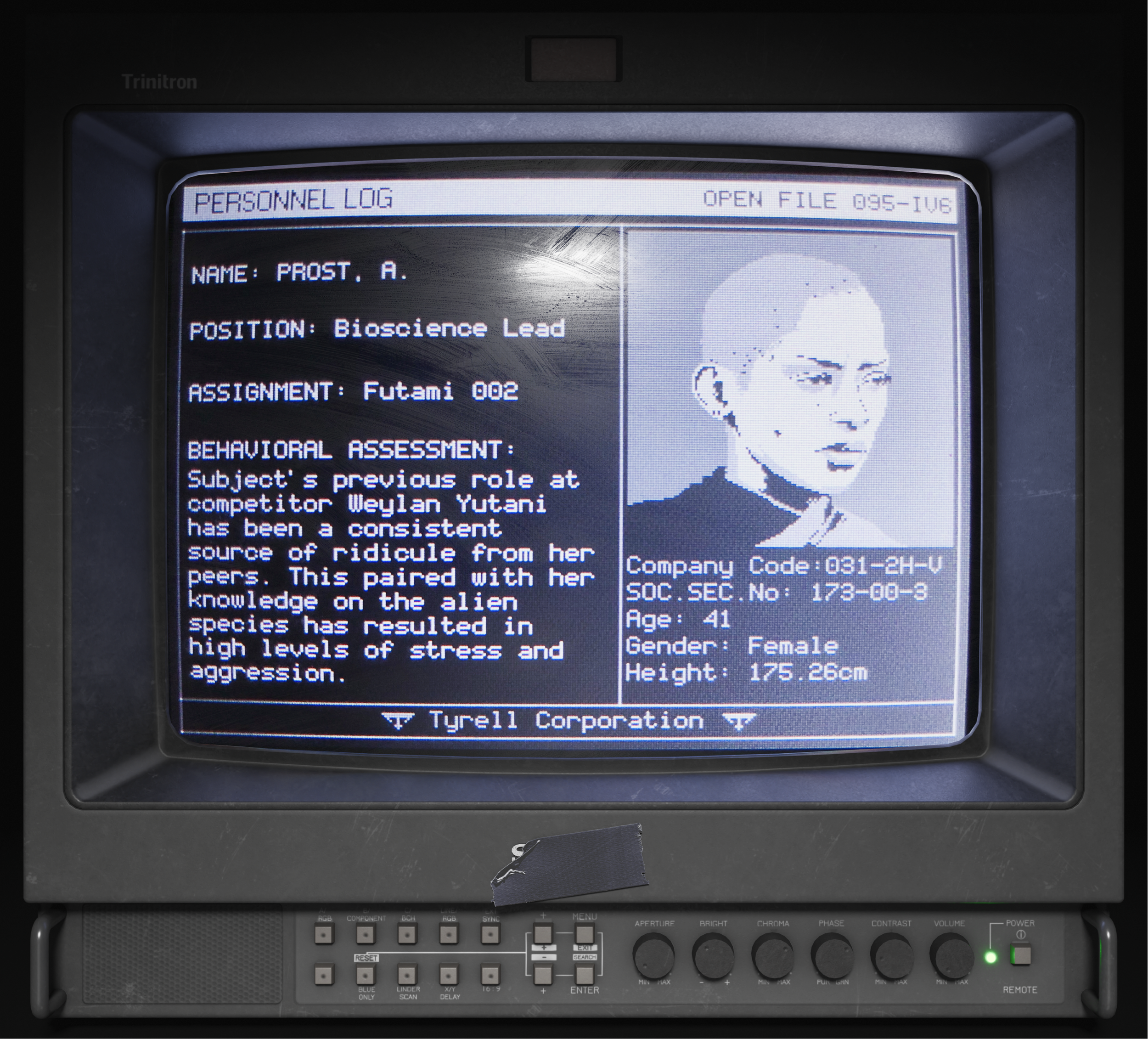
The character’s motivation is similar to the Biosyn characters in Jurassic Park. They (Tyrell Corp employees) are chasing the more advanced Waylin Yutani teams to the Alien home planet. They are driven to the discovery vs a payout. Which might be harder to connect the Alien’s “truckers in space” but their over ambition will be a lesson everyone can relate to.
Layout for these character screens is heavily inspired by the Blade Runner 2049 prop work of Adam Shefki with a dash of Alien Isolation's screen designs.



Human Elements
World Building
For PILOT I'm combining the worlds Alien and Blade Runner. Tyrell Corp and Weylan Yutani are corporate competitors in Pilot much like InGem and Biosyn in Jurassic Park. I want PILOT to feel like 1979 Alien at first glance. The secondary impression is to notice the Blade Runner influence. Therefore you will see a combination of design styles from Ron Cobb and Syd Mead.
Tyrell Corp Logo Redesign
I took a stab at redesigning this logo (briefly seen in Blade Runner) since it will appear throughout PILOT. I removed the owl reference and simplified the “T”. I also wanted to contrast the Waylan-Yutani logo which is softer and has visual references to wings/feathers. I assume as a way to make the corporate giant appear a little “softer and natural.” I took a more modern approach (although less nuanced) to logo design for Tyrell. Since it is a company focused on synthetics and technology, I felt it would make sense to reflect the nature of the company in the logo. So it’s now machined and technical. Which is why it looks a bit like the old IBM logo. I also wanted to incorporate some of Pilot’s visual DNA with linear repetitions.

Icon System
My design for the ship’s wayfinding is directly inspired by Ron Cobb’s Semiotic Standard icons from Alien. With a few variants on the system. I made everything rounded (lower res for the screen icons) and monochromatic. The red acts as an attention grabber, similar to exit signage, for the crew. To the audience, the red accents the monochromatic blue environments and adds a layer of world building detail.

Orbiter Ship
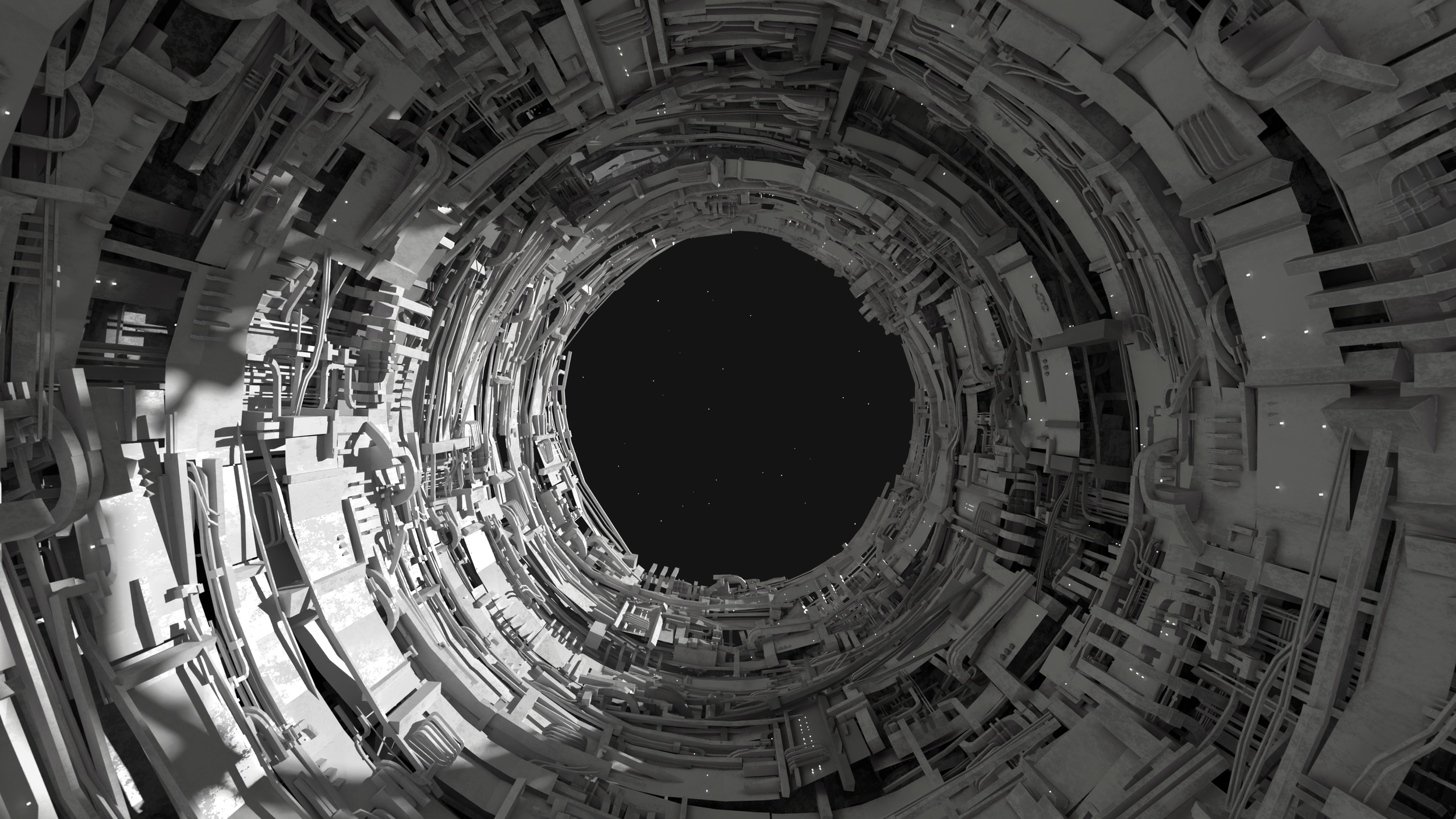
My initial designs took the iconic pyramid buildings from Blade Runner and flipped them upside down…A trick I learned watching Total Recall’s behind-the-scenes, where they flipped art deco sky scrappers to get the look of the alien reactor’s fusion rods. But after some exploration it didn’t feel industrial enough for Pilot. So I went back to oil refineries which inspired the Nostromo’s look. I also followed a similar process the model shops used on Alien to get all the detail by 3D modeling my own greebles. I looked at a range of ship model details from Alien, 2001, Star Wars, and some 1970s spacecraft concept art for my set. The elevation of this craft formed a “T” (happy accident) and is a subtle tie back to “Tyrell.”
The Dropship
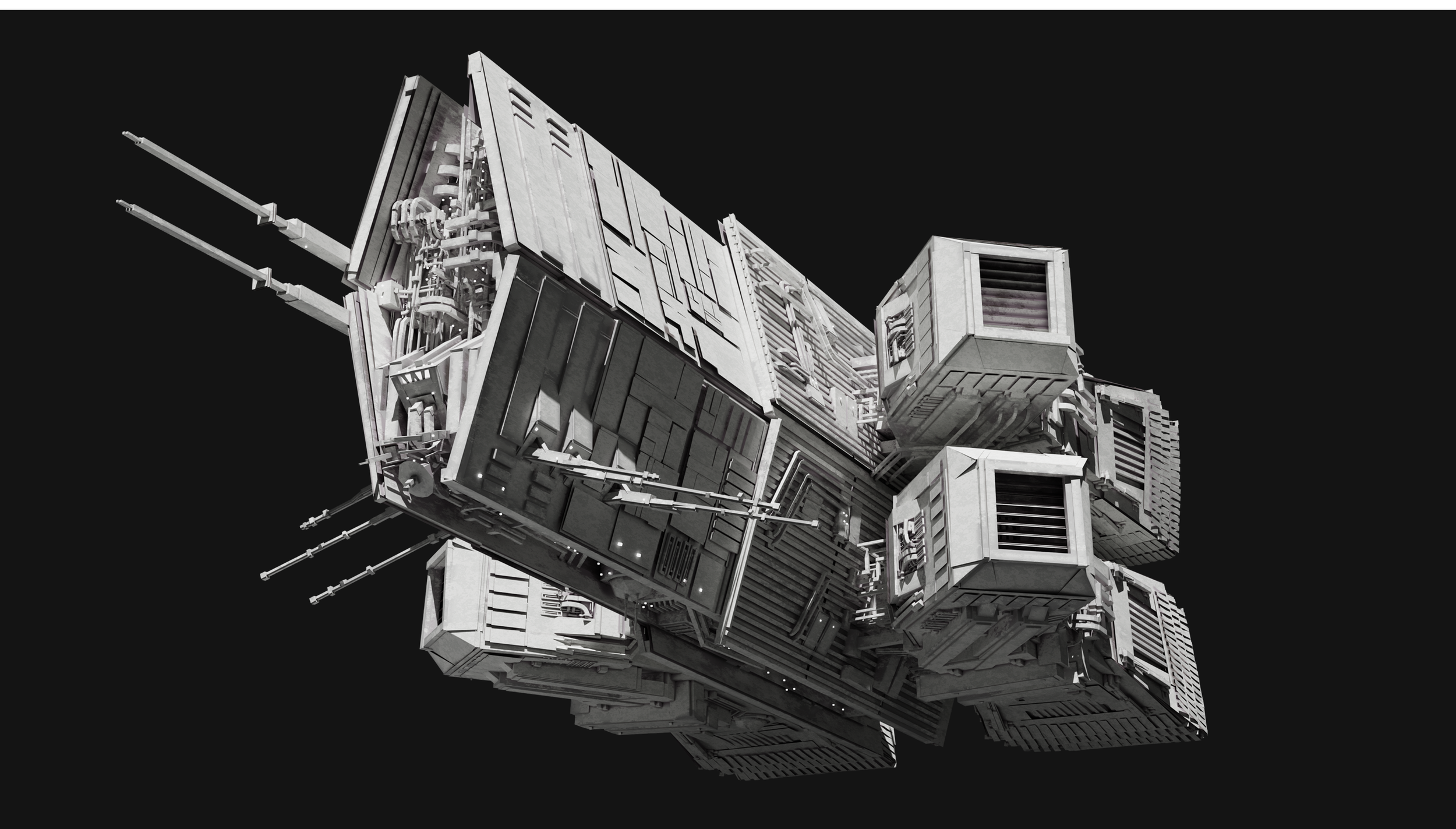
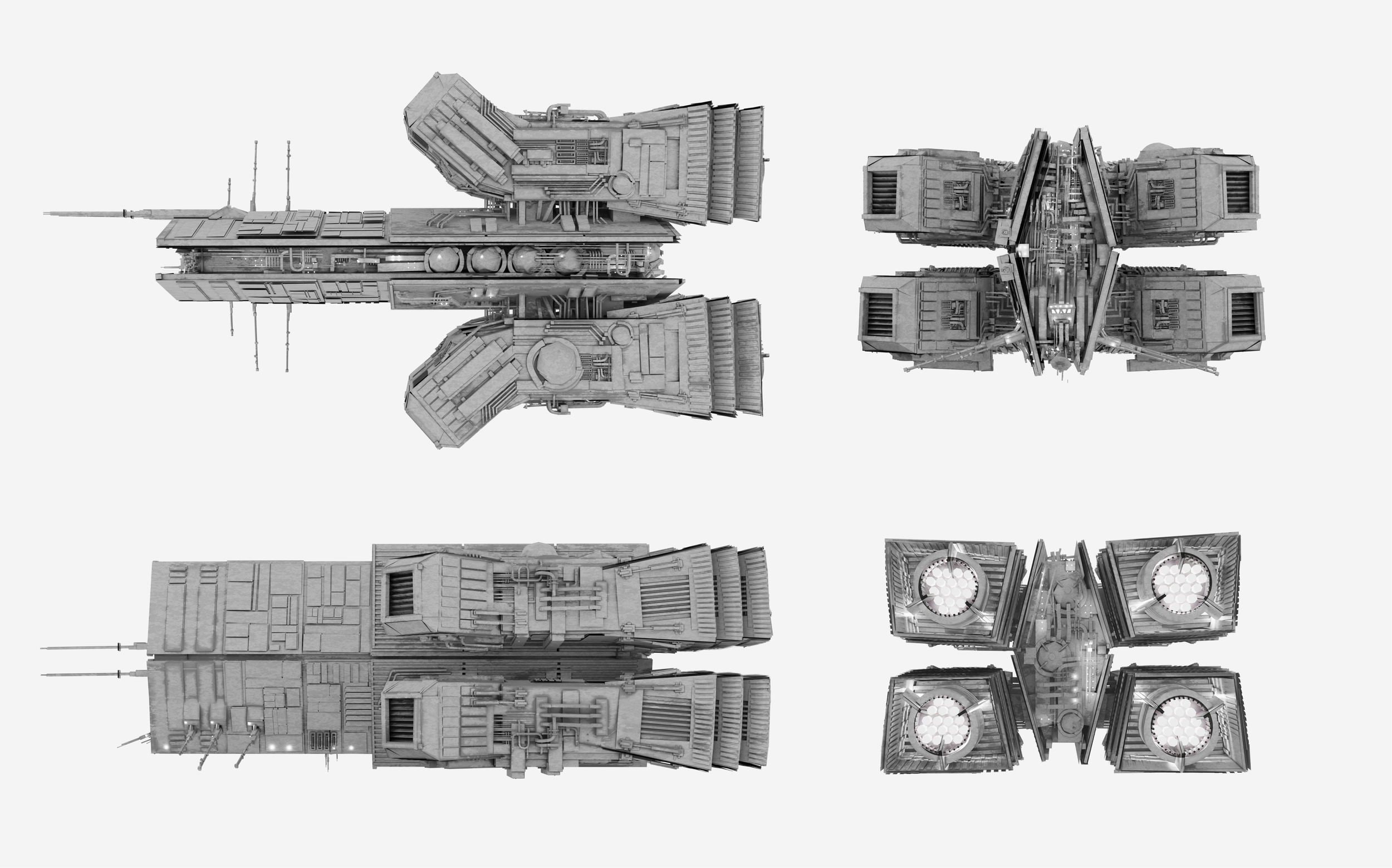
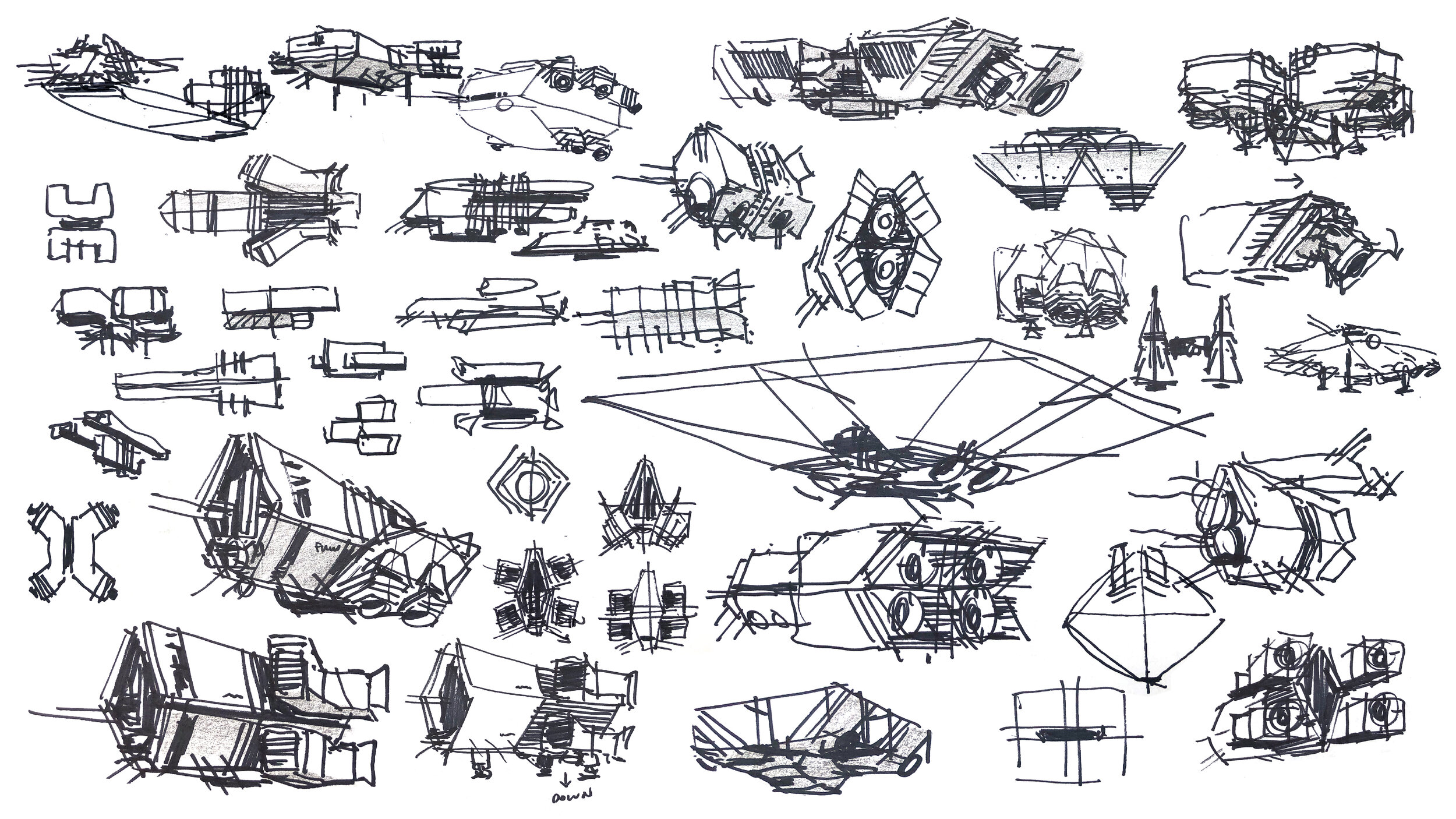
Designing a spaceship is like designing a logo. Everything has been done and every angle explored. It took me a while to land on an overall concept I was happy with. I basically frankensteined Syd Mead and Ron Cobb. Since my story merges universes I felt it's fair to merge designer references as well. I also combed over model details, in Alien, to capture the kitbash vibe.
The Dropship’s primary visual design motif is its telescoping forms. You can see this on the core body, surrounding the engines, and on the landing gear. Repetition is a universal visual motif all throughout Pilot. Even all the way down to how everything is modeled with the repeating Quill strokes.

Dropship Landing Gear
As you venture out of the airlock, the dropship's landing gear is there to greet you. Like towering industrial skyscrapers. They are dangerous to be around and make you feel like you're working in an unstable factory - populated with massive machines that can kill you instantly without prejudice.
This will be another key spot to show off the visceral aspects of VR (scale and verticality). The design is a mix of the landing gear from Alien, and my new dropship design. To make it cohesive I pulled the repetition that happens on the dropship’s engines and used that for the feet. I also repurposed greebles from the dropship for the mechanical details.
Ship Interiors
Overall design for the ship's interiors is a mix of Alien and Blade Runner's living spaces. As the story progresses so does the mood of the interiors. Each set progressively becomes darker evoking a sense of growing dread and fear. This also helps me limit detail since most areas will be in pure shadow.
The workflow for creating each scene is very labor intensive. The final assets are hand painted, detailed, and optimized. I’m constantly asking myself if this is too much but I think it will pay off in the end. As creation becomes more accessible and automated with AI, I believe works that are a labor of love will have higher value. Doing things the long/hard way gives things a sense of weight and pride that automation cannot. The audience can feel that.

The Decision Scene
2025 Test: This will be the most important scene in Pilot. It has the most dialog, plot, and character animation to cover. If I can make this scene work then the rest should fall into place. Pilot has a long way to go but the project finally has a pulse.
For the voices I used speech to speech synthesis (my voice performances with filters layered on). Only to flavor the characters. This animatic will eventually help me direct voice actors. It desperately needs their performance.
Learnings from the Animatic test:
The only way I can ever finish Pilot is to animate characters via pose to pose. Maybe add some in-betweens after release if I have the energy.
No lip syncing. Possibly binary (open/close) anime style mouth movements. But I need to test this and see if it looks corny.
Use background ambience to reinforce tension. Like in Alien I used a rhythmic industrial “heart beat” pulse for the ship's ambience. I made it increase/decrease “heart beat” tempo based on the group's mood. I also increased the background presence during pauses to increase the “silence” and uneasiness.
Updates:
The script is now more coherent and sharp. It was hard to follow since I was leaving out specifics that glued things together. I trimmed pauses and reduced character dialog to shorter bursts. You can really feel when things get too long in VR. Especially in the middle of this scene. Expressionless faces don't help either. There's not much for the audience to study during the longer portions.
I added more foreshadowing to what the characters will face later on. The first draft retreaded too much territory from Alien and was way too bloated. It's sharper and focused now.
The main climax of this scene is still not yet justified. The middle part of the convo goes a little off track making it harder to snap back in. Maybe actor performances can help set up the main line. Or the scenes leading up to this one could have little seeds planted to help set things up. Not sure yet but this is where I need to focus next.
Alien Home World
Everything in the second half of PIlot will be in direct contrast to the first half. Instead of the cold machined feel of space and human ships, the alien planet will be full of flesh tones and organics.
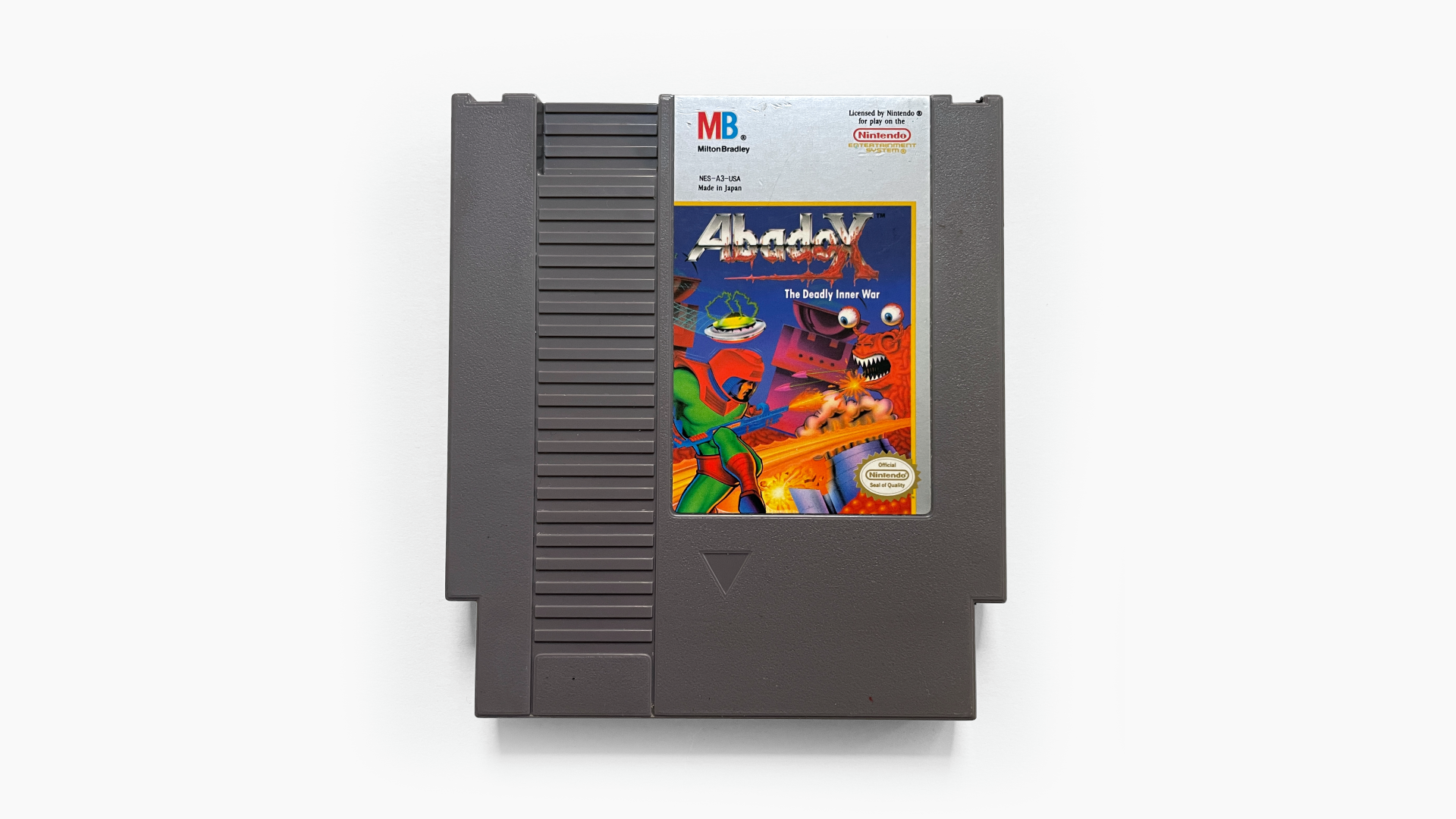
In Giger’s Alien Diaries, and an interview I saw but forgot where, HR Giger expressed a vision for the landscape (LV-426) to be "living" or “grown”. But for time/budget reasons the idea was scrapped. Since my story takes place on the thriving alien home world I decided to bring this idea back. There's been a few projects over the years that take on this concept of a living/organic planet. One that comes to mind is the NES game Abadox. It's a fun snapshot into the gross alien world I want my characters in Pilot to explore.
World Design
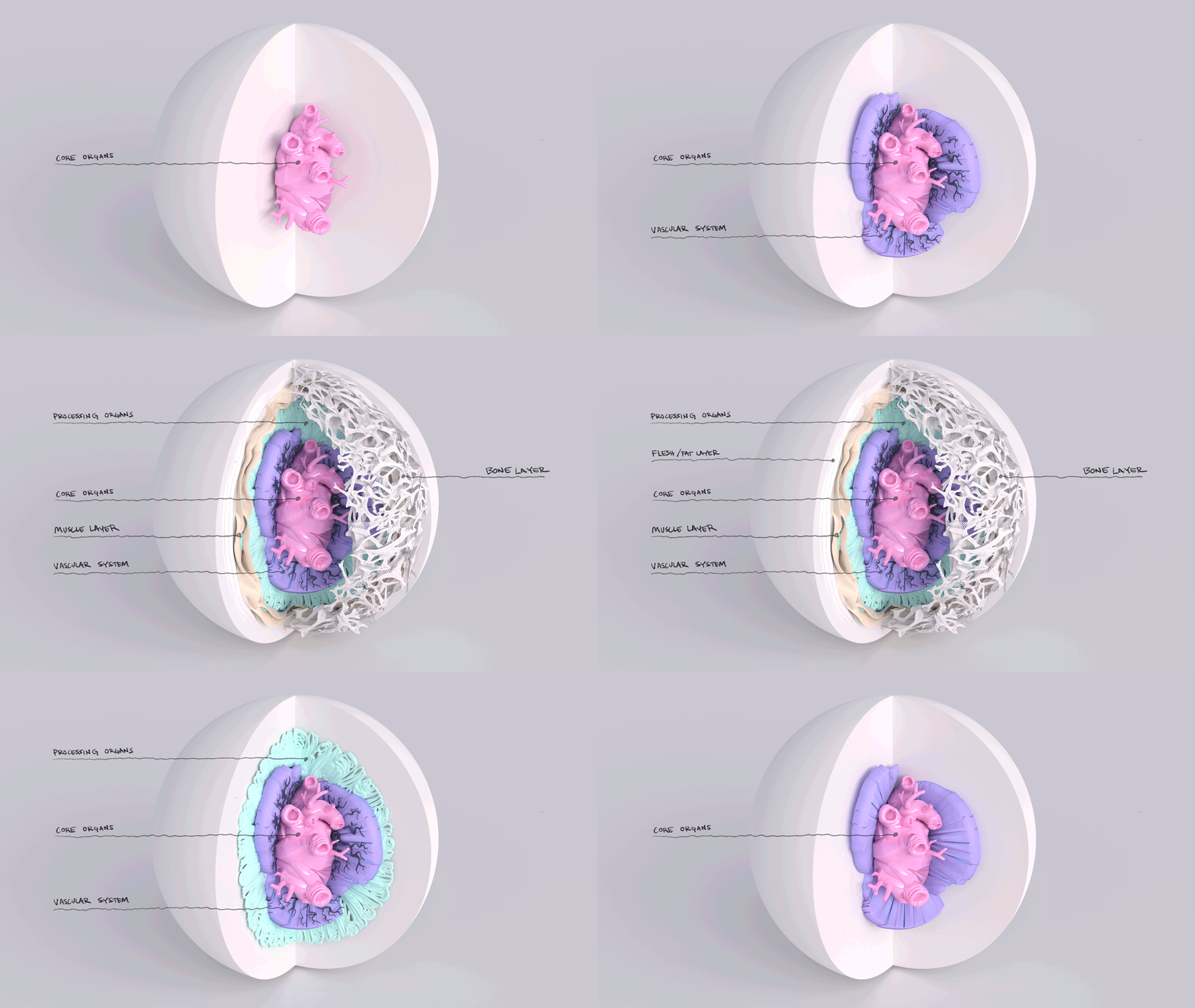
Rhythmic quakes shudder through the ground, driven by the planet’s immense internal organs as they pump vital fluids from the core through a vast vascular network. With every step, the character’s boots sink into the yielding, fleshy terrain, triggering reflex spasms in the muscle fibers just meters below. The dropship’s touchdown is an act of sheer violence; its weight shatters colossal, subcutaneous bones that rupture through the crust, unleashing torrents of organic fluid from the deep gashes. The atmosphere is stifling and thick, choked by low-hanging clouds of heavy gas. Even through the filters of a pressurized suit, the planet's foul smell bleeds in. It's a shifting, stomach-turning palette of copper, raw meat, and sour yeast.
Space Suit Design
Not only is the alien planet a big design challenge but the Tyrell Corp space suits as well. For the final design I referenced Moebius’s pre-production sketches, from Alien, and layered on organic elements from other films. There's also a thematic similarity to the Space Jockey for suggestive story reasons.


Side Quest
Pilot has been a great vehicle for learning. I work on these little side projects in parallel to the main production. Learnings from these projects make their way back into the main production one way or the other.
“Bio-mechanical Interface”
Details the Space Jockey’s technology and how they might interact with it - I imagine it to be like the scene in Predator where the creature repairs itself in the trees. But for Pilot it's more gross and organic.
This was sparked from an exercise in making my renderings less “clean” and more oddly textured.
“Bio-Excavation Facility”
This project explores events after Pilot. The Alien planet is a bio-mechanical organism. The Tyrell Corp has set up a facility to excavate the planet’s organic surface layers.
This was an exploration into “fear of heights” for VR, as well as, viewer agency in Quill.
“Mashed Parts”
This project explores how other indigenous life on the Alien plane might look like. I ended up kit bashing parts from the Alien species and the Space Jockey. This is a head from one such indigenous creature. Probably a giant like the Space Jockey.
“Projections”
This started as a 3D scanning test and ended up as a weird experiment for all sorts of techniques. The 3D scan results reminded me of the scene in Alien where the crew interrogates Ash. So naturally I had to capture that vibe. This became a 3D study of all the practical effects in that scene.
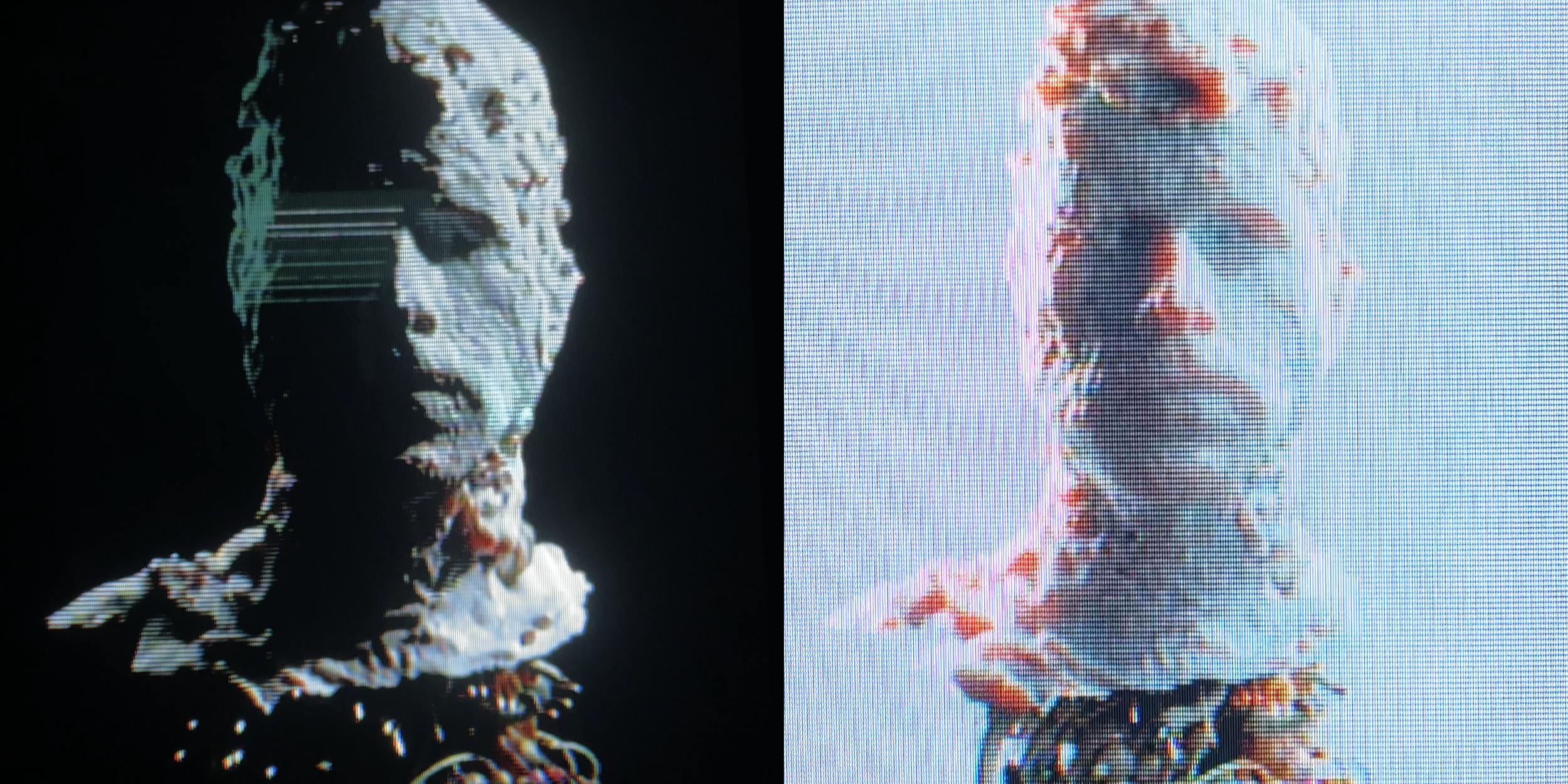
“Wireframe Weirdos”
This was me having fun while working on an animatic for the decision scene in Pilot. I created puppet style rigs for all the characters and decided to be playful with the rigs vs. actually working on the animatic.
Learnings
There’s a reason long tech inspired projects struggle - the world moves on. Things change. If a technology is a key component to your project then your project is also at risk of fading into obscurity along with the tech. That’s why I started putting more energy into other aspects of Pilot. Ultimately I'm happy with the core story themes, lore ideas, and design work so far. So now the project has more novel stuff to offer than just being a VR showcase.
Motivation via small and frequent milestones - To keep myself motivated I create mini milestones along the way. Usually in the form of strategic side quest projects. Each adds to the overall project and helps me learn/grow.
Allowing off ramps leads to new directions - I get bored of Alien, and this project, from time to time. It doesn’t always fit into my top of mind creative interest or goals. So sometimes I take parts of Pilot and use them to explore elsewhere. Since the content is rooted in Pilot it can come back and add to the overall project. But it doesn’t have to and that freedom is what allows for creative expansion. It's only later do I find ways to bring these off ramps back in. In that flow I have more creative freedom to find exactly how they can integrate and contribute to the main project.
A sandbox of experimentation to test changes in the world - Over years the world, tech, and myself go through big changes. The biggest tech distribution during Pilot has come from gen AI and LLMs starting in 2022. In many ways I feel spiritually connected to Phil Tippett and his Mad God project. There he experienced a similar disruption with the digital (CGI) revolution in the 90s. In many ways I feel like Gen AI has also torn apart my creative life like CGI did for Tippett. Though I can't really compare given how badly he was affected. But it impacted me enough to weave Gen AI into Pilot as its core narrative warning.
Pilot grows with me - There are sparks and seeds to Pilot. Universal ideas planted in the start that will show up in the final result. DNA basically. But this project will evolve as things emerge and I grow as a person. Allowing for the project to evolve with me frees up a lot of pressure. In many ways this project is more like an organism than a static pipeline. It has a DNA that will remain but can organically change over time. All projects evolve but rarely connect with your personal evolution and changes. Especially since I share 10 years of my life with this project.